CT imaging is no longer something only large hospitals use. In the past few years, veterinary CT machines have become one of the most important diagnostic tools for animal hospitals, pet clinics, and university teaching labs. But many buyers still ask the same question:
“Can we use a human CT machine for animals?”
“What’s the actual difference between veterinary CT and human CT?”
“Is it worth investing in a CT made specifically for animals?”
If you’re planning to add CT capability to your veterinary clinic, this guide will help you understand the differences clearly, avoid costly mistakes, and choose the right equipment with confidence.
Technically speaking, both veterinary and human CT systems use the same imaging principles:
• X-ray beam rotates around the patient
• Multiple slices are captured
• Software reconstructs cross-sectional images
• Doctors analyze structures in detail
So if the core physics is identical, why do manufacturers build separate CTs for animals?
Because animals are NOT small humans — they vary in size, behavior, anatomy, and sedation requirements. A CT scanner must therefore be designed around:
Different body shapes (pets, livestock, exotic animals)
The need for deeper imaging angles
Longer scan ranges for long-bodied animals
Stronger table load capacity
Faster workflow with sedation or anesthesia
More flexible positioning
That’s why veterinary CT systems look similar to human CTs — but operate very differently.
Human CT:
Humans lie still on the table and follow breathing instructions. Easy positioning.
Veterinary CT:
Animals must often be:
✔ sedated or anesthetized
✔ fastened in special positioning pads
✔ supported with extended-range table movement
Veterinary CT tables usually offer:
Wider motion
Stronger load capacity
Height adjustability
360° access around the animal
This ensures stable and safe imaging, even for large dogs or exotic species.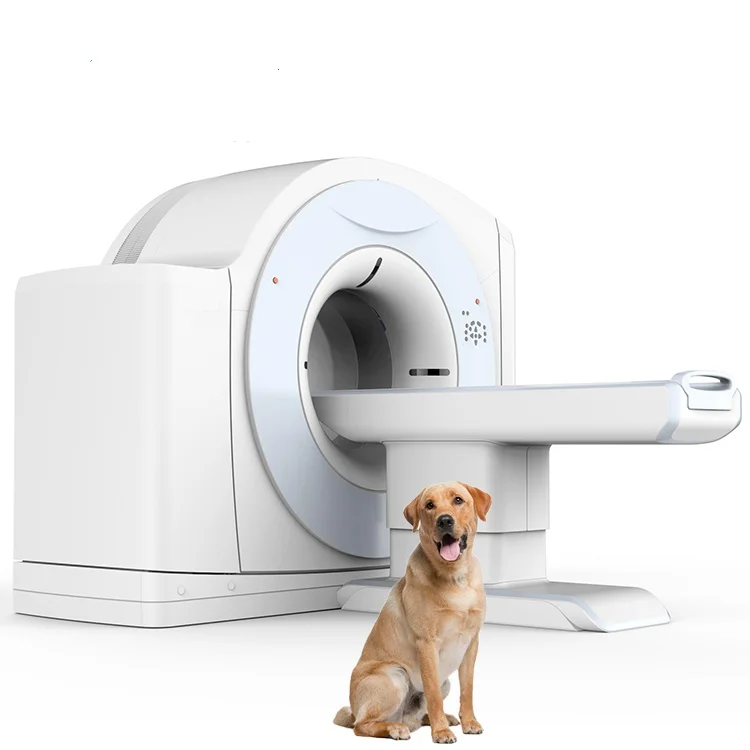
A human CT gantry is optimized for torso and head exams.
A veterinary gantry must accommodate:
Long bodies (dachshunds, ferrets, large dogs)
Short but wide bodies (pugs, bulldogs)
Long-neck species (horses, llamas)
Therefore, many veterinary CT systems feature:
Wider bore diameter
Expanded table travel length
High-speed scanning to minimize anesthesia duration
These details dramatically improve diagnostic accuracy for veterinarians.
This is one of the biggest differences.
Human CT software includes head, chest, abdomen, spine protocols — all based on human anatomy.
Veterinary CT software includes:
Species-specific presets
Soft tissue and bone algorithms for animals
Dental CT protocols (very common in vet imaging)
Automatic contrast timing for different species
Airway and lung preset for animals
3D reconstruction tailored for veterinary anatomy
This means a veterinarian can get the best image quality faster, without manually adjusting parameters.
Human CT:
Dose is strictly regulated — especially for pediatric imaging.
Veterinary CT:
Animals tolerate different dose ranges, but the concern is still:
Staff safety
Short scanning time
Reducing anesthesia duration
Veterinary CT machines are typically optimized for fast scan + high clarity, ensuring each exposure is efficient and minimizes repeat scans.
Human CT workflow is highly structured, with DICOM and HIS/PACS connectivity built around hospitals.
Veterinary CT workflow is more flexible:
Vets often perform multiple exams in one session
Animals require anesthesia monitoring
Clinics need easy switching between species
Images must be quickly shared with pet owners
Many veterinary CT systems include:
Simplified UI
One-click species protocols
Cloud backup for case sharing
Integrated anesthesia monitoring port
This workflow is more suitable for clinics than a refurbished human CT.
Human CT machines (brand new):
USD $100,000 – $350,000+
Veterinary CT machines:
USD $45,000 – $160,000 depending on:
Slice count
Table size
Software options
Detector technology
Most veterinary hospitals don’t need high-end 128-slice CTs. A 16-slice or 32-slice veterinary CT is already ideal for:
Orthopedic injuries
Nasal cavity issues
Tumor screening
Dental problems
Lung diseases
Spinal evaluation
Internal bleeding
Trauma from accidents
This makes veterinary CT far more cost-effective and higher ROI.
Technically yes, but with limitations.
👉 Challenges:
Software not optimized for animals
Positioning issues with long-bodied pets
Higher radiation dose
Complicated workflows
No dental CT protocols
Service costs are higher
Many refurbished human CTs lack spare parts
👉 The biggest issue:
You pay more but get poorer veterinary performance.
Human CTs are also regulated as hospital-grade equipment, meaning installation can require:
Additional room shielding
More certifications
Higher maintenance fees
In contrast, a modern veterinary CT is simpler, faster, and cheaper — while giving better diagnostic results for animals.
In the last 3–5 years, demand for veterinary CT has exploded. Pet owners want answers quickly, and clinics with CT capability attract more high-value cases.
Top benefits driving the trend:
Vets can detect conditions earlier and treat more effectively.
Shorter scanning means less time under anesthesia.
CT imaging becomes a major income source with fast ROI.
Pet owners feel more confident when a clinic offers advanced imaging.
Clinics offering CT stand out immediately in their region.
If you want to grow your veterinary hospital, CT is one of the most influential upgrades you can make.
Here’s a simple checklist to follow:
Pets only?
Large animals?
Exotic species?
Your answer determines table size and bore diameter.
Orthopedics
Neurology
Dentistry
Soft tissue
Trauma
Some CTs handle bone imaging better, while others offer superior soft tissue algorithms.
Faster scans = safer anesthesia.
Modern vet CTs are compact and easier to install.
Always choose a supplier with stable support — like Fatali-Med.
Veterinary CT delivers high return because pet imaging is in strong demand.
Fatali-Med has 22+ years of medical manufacturing experience, and we supply complete veterinary imaging solutions — including:
Veterinary CT
Veterinary DR X-ray
Veterinary ultrasound
Veterinary monitors
Endoscopes
Surgical equipment
Our veterinary CT solutions offer:
✔ High-resolution imaging
✔ Multi-species presets
✔ Dental CT mode
✔ Fast scan for safe anesthesia
✔ Durable table for large dogs
✔ Easy training for clinic staff
✔ Competitive direct-factory pricing
✔ Global shipping and online engineering support
Whether you're upgrading your clinic or building a new veterinary imaging department, Fatali-Med provides a full, cost-effective CT solution that’s ready for daily clinical use.
Although veterinary CT and human CT share the same core technology, their design, workflow, software, and clinical usage are completely different. For any clinic treating animals, a dedicated veterinary CT machine offers:
Better imaging results
Safer workflow
Faster exams
Lower total cost
Higher clinic revenue
If you're planning to invest in imaging equipment this year, a veterinary CT system is one of the smartest decisions you can make.